
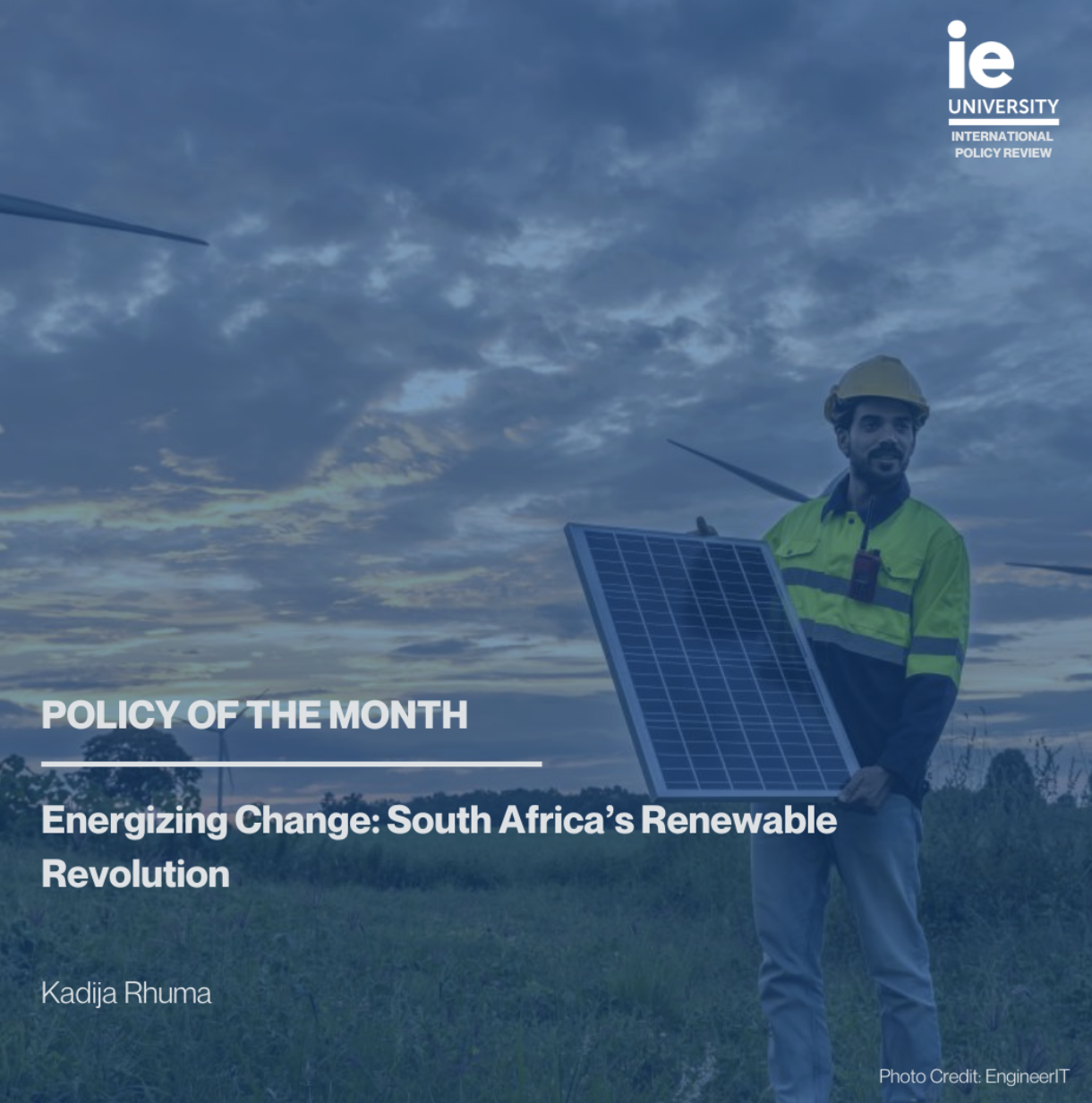
23 Dec POM: Energizing Change: South Africa’s Renewable Revolution
Kadija Rhuma
International Policy Review – Policy of the Month
December 2025
The electricity crisis in South Africa is more than flickering lights; it is a crisis that shapes daily life,
limits opportunity, and reinforces inequality. When power fails, children cannot study, businesses cannot
operate, hospitals risk losing lifesaving capacity, and communities lose faith in institutions. In South Africa,
decades of inconsistent policy, corruption, and weak institutional capacity have compounded these
pressures, leaving millions without reliable access to electricity.
In response, the government introduced the Renewable Energy Independent Power Producer
Procurement Programme (REIPPPP) in 2011.
This program aimed to attract private investment, expand renewable energy generation, and stimulate job creation. Over time, it has drawn billions in capital, created thousands of jobs, and begun to reshape South Africa’s energy landscape. Yet while its successes are clear, the
program has also revealed trade-offs: declining local ownership, dependence on foreign capital, and uneven
benefits for low-income communities.
READ THE FULL ARTICLE HERE
Sorry, the comment form is closed at this time.