
IE INTERNATIONAL POLICY REVIEW
The IE International Policy Review is a student-led academic journal founded in 2018. Since then, the Editorial Board has aimed to publish the highest quality social sciences academic papers. Our review provides everyone, starting from their first year, the opportunity to master the art of writing and editing. This fosters the ability to critically analyze global events and explore creative policy-making solutions.
The IE International Policy Review is built on the belief that intellectual debate is essential for fostering innovation. We believe that development in every field is a direct consequence of thoughtful and factual analysis, regardless of one’s political or social standing. The review welcomes every respectful opinion and encourages a scientific and academic approach to current events.
LATEST PUBLICATIONS
Acknowledgements
The IPR has always been a team effort. This edition, like all others, acknowledges the invaluable work of a number of individuals without whom its publication would not be possible.
First and foremost, we express our gratitude to the IE School of Politics, Economics and Global Affairs for their unwavering support in pursuing our mission. In particular, we would like to thank Vice-Dean Borja Santos Porras, Executive Director of Undergraduate Programs Fernando Menéndez, Senior Associate Director Betsey Medow, Associate Director Santiago Sierra and Junior Manager Maria José Villegas. Our heartfelt appreciation also goes to the IE Campus Life Department, especially Executive Director Elisa Hicks and Student Experience Coordinator Valentina Farray.
This publication prides itself on its commitment to diversity which it also pursues through its collaborative chapters. We remain incredibly grateful to have encountered partners across borders who have related to our mission time and time again. Our special thanks extend to The SciencesPo Sundial Press, and particularly to Celeste Wang and Nikola Kralev. Additionally, we are honored to partner with Bocconi Advocacy and Litigation. We highly value their constant support and collaboration, especially that of Carlo Matarazzo and Guya Scaringi. Although not included in this issue, this semester we also wish to acknowledge the partnership with Next Leaders by Forbes Italia, particularly Eric Petersen. We deeply admire your work. We are also grateful to the members of our Advisory Board, Ecab Amor Vasquez and Theresa Amor-Jürgenssen, for their continued support.
Behind every page of this issue stands a team that went above and beyond to ensure great editorial quality, coordination and visibility. Through weekends, holidays, and late evenings, they carried this work forward with a quiet persistence that never wavered. We are proud to work alongside our Heads of Chapters, Maria Luiza El Awar, Agustín Plaza De Los Reyes Álvarez and Richard Glatter. You set the standard for what dedication looks like. A special thanks to Gabriela Vázquez- Guillén Navarro for her continued commitment to the IPR Policy of the Month. For ensuring that everything ran smoothly, we thank Elena Panté, Sofía Affronti, Kyler Matthew Reyes, Sofia Perfeito Falleiros, Teodoro Sierra Ramirez and Ketevan Saakashvili. We are also grateful for the technical and operational support of Agnese Lurgo, Camille Deltchev and Weronika von Lonski. Much of the recent growth and innovation of the IPR vision has been led by Henri Klein, whom we are proud to have on this journey. Thank you to his incredibly dedicated team including Kaya Schmidt, Gloria zu Salm, Alexandra Björkman and Olivia Morse. We look forward to accelerating this growth together.
Finally, as this represents a transitional issue for the IPR, we wish to highlight the contributions of some outgoing members that have left the publication much better than they found it. To Alexia Dimitriou, few individuals have gone so far beyond what was asked. Thank you for your tireless dedication. Isabela Rodacki, it is no exaggeration to say this issue would not have survived without you. Thank you for your continued support.
One name deserves to be set apart for her exceptional commitment to the publication over a number of years. Matilde Romagnoli, whatever comes next for the IPR will be built on the foundation you laid. It has been a privilege to watch you pour yourself into this and we count ourselves lucky to have been led by you. On a personal note, working with you has been an incredibly rewarding experience.
Andreea Pascaru
Editor-in-Chief, IE International Policy Review
Dear Reader,
It is my honour to welcome you to Volume 7, Issue 2 of the IE International Policy Review. With every page, this publication stays true to a simple commitment: that students are capable of serious scholarship, and that the questions they choose to ask deserve focus and consideration. All articles in this edition, across the Law, International Relations and Economics chapters, are evidence of that conviction as well as of the countless hours of research, writing and editing that preceded the version you are seeing today.
If there is a single quality that embodies the spirit of the IPR across chapters, it is a deep sense of intellectual curiosity and passion for academic inquiry. Curiosity reflects the instinct of asking “why”, instead of taking apparent facts at face value, and it is what has turned every article in this edition from a broad topic into a well-thought-out argument worth defending. Curiosity improves existing systems, designs better policies and solves the biggest debates worldwide. Our writers come from diverse ethnic and academic backgrounds, yet they share this unique willingness to question the status quo. To follow a line of inquiry until you have something new to say about it is no easy feat. But it is what separates an academic article from an opinion, and it is the standard that the International Policy Review holds itself to.
That same spirit is what makes this review more than a set of articles. The IPR is a shared journey bringing together like-minded future professionals with an ambition to make change. It is the connection we strive to design between writers and editors that sets us apart and we remain committed to providing an experience that encompasses more than just a publication outlet. We are dedicated to supporting members from the very first meeting, all throughout deadlines and beyond publication. This is rooted in our belief that academic scholarship is enhanced through collaboration.
As I take on the position of Editor-in-Chief for the year ahead, it is my hope that the IPR remains curious, that we ask even better questions and dig even deeper to find the answers. I am proud of the edition brought to you today and I hope you take as much enjoyment in reading it as we did in producing it.
Sincerely,
Andreea Pascaru
IPR Editor-in-Chief
Acknowledgements
My gratitude goes to the Vice Editors-in-Chief, Isabela Rodacki and Alexia Dimitriou, for being essential in keeping the Review rigorous and functioning, as well as to the Heads of the Chapters, Henri Klein, Andreea Pascaru, Alberto Alonso Inope La Rosa, and Vrushab Shekhar, for their wonderful work.
A special thanks to all the members of the team, Agustin Plaza, Sofia Falleiros, Maria Sofia Affronti Casella, Maria Awar, and Kaya Schmidt, Gabriela Vazquez-Guillén Navarro, not only for their dedication, but for believing steadily in this project and trusting its vision. A special thanks goes to Elena Pantè for going above and beyond to ensure that this issue embodies the love she has for her discipline — passion is at the core of the IPR, and she does everything to keep that fire alive. My deepest gratitude also goes to Weronika Von Lonski, for her commitment to this project, and to the events team, Aicha Fehri and Elena Karam, for ensuring that the IPR is more than just words, but that it also brings concrete value on campus.
Last, but definitely not least, thank you to all our partners, chapters, and collaborators for giving us the opportunity to keep growing, improving, and enjoying the process along the way. A special thanks to Eric Peterson for enabling connections and fostering our growth.
As always, thank you to IE SPEGA and IE Campus Life for offering us the platform to continue
pursuing this project and for believing in us, we are proud to be part of the IE community.
Faithfully,
Matilde Romagnoli
IPR Editor-in-Chief
Writing a paper is never a simple act; it is an exercise in uncertainty, especially in an age in which reality itself feels increasingly complex, fragmented, and relentlessly politicised. Information is no longer merely accessed but it is contested, framed and fought over. In such a context, the most valuable skill we can cultivate as students is the capacity for free and reflective thought.
To write, and to edit, is to enter a space of constant self-interrogation. It forces us to ask whether what we present truly reflects the world as it is, or rather the world as we see it, shaped by assumptions. It compels us to confront opposing theses, to sit with discomfort, and to reassess beliefs we may have long taken for granted. For an editor, this process is even more demanding: one must learn to distinguish between an argument that requires refinement and to recognise when argument may be valid even if it does not align with one’s own views.
At the IE International Policy Review, every article published is the product not solely of an individual author’s insight, but of a vibrant community that challenges perspectives, sharpens ideas, and pushes one another beyond familiar comfort zones. Freedom of thought cannot exist in isolation; it is born from the encounter of diverse ideas, through confrontation and, at times, productive clash. It is our hope that within this issue, readers will find not definitive answers, but questions worth lingering over and, above all, food for thought.
Clearly, at the heart of this journal there is a shared effort, and I owe my deepest gratitude to an Editorial Board that made collaboration its defining strength.
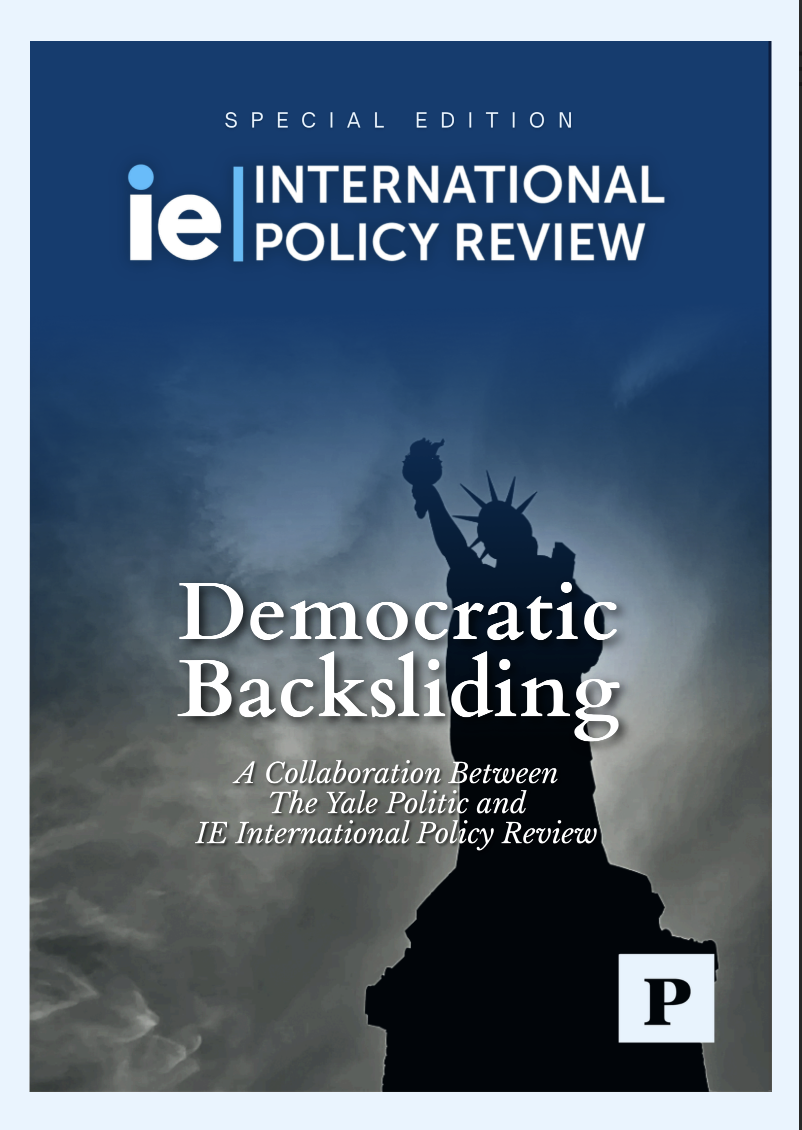
Acknowledgements
In this special edition, the Yale Politic and the IE International Policy Review come together to analyse the topic of Democratic Backsliding.
Acknowledgements
This issue would not have been possible without the contributions of many valuable people.
We are particularly grateful to the entire IE School of Politics, Economics and Global Affairs for their constant encouragement and support, especially to Borja Santos Porras, Fernando Menéndez González, Betsey Medow, Santiago Sierra, and Agostina Blengino for believing in us.
A special thanks to IE Campus Life, particularly Valentina Farray and Elisa Hicks, for always dedicating their time and kind words to us.
Thanks also to the past Editors-in-Chief, Karan Khosla, Kyler Cade, and Zachary Zimmermann, for entrusting us with carrying forward the vision they had for the IE International Policy Review.
We would like to express our deepest gratitude to our partners, without whom we would not have been able to grow so much over the past few months.
A special thanks to Giuseppe Valerio Bonanno, Francesco Fernando Annese, and Pietro Zaccardo from Bocconi Advocacy & Litigation for showing great enthusiasm since the beginning of our collaboration and for their incredible work.
A heartfelt thanks also to George Newcombe from The Sundial Press for the exciting projects we had the pleasure of sharing.
Our gratitude also to the IE MUN Committee for our exclusive 2024 collaboration.
Most importantly, thanks to all the writers, editors, and past and present members of the IE International Policy Review who allowed us to guide them on what we hope has been a pleasant writing journey. We thank you for your hard work, ideas, and great articles. Without you, this review would not exist. You represent the mission of the IPR, and we are proud to have you.
Last but not least, thank you to our wonderful team for working incessantly and with the greatest passion for this review to be out today. Thanks to Claudia Espinosa Segura, Paul Prinz, Vanessa Ileana Chiaoaru, Nikola Pantelić, Stephanie Villamor, Alexia Dimistriou, Lucas Phillips, Alberto Alonso Inope La Rosa, Vrushab Shekhar, Francesca Etienne, Alfredo Echeverria Castro, Anastasiia Bolkhovitina, Andreea Pascaru, Constantine Mosch, Gabriella Vázquez-Guillén Navarro, Isabel Goméz Araujo, Isabela Bortolotto Rodacki, and Weronika Von Lonski.
A special thanks to our advisory committee for supporting us throughout the publication process, especially to Ecab Amor Vazquez, Theresa Amor-Jürgenssen, Alejandro Dib Parada, and Aurora Dell’Elce.
Finally, thanks to our wonderful Mia Leonardo for making sure the IE International Policy Review always “looked great” and for turning us into the professional club we are. We are immensely grateful for your help and dedication.
As we celebrate the 6th Journal and the 2nd issue of the IE International Policy Review, we also take pride in the diversity of articles, viewpoints, and opinions that this publication brings together. At a time when differing perspectives and approaches are often criticized or silenced, we choose to celebrate them.
Every article in this issue upholds the academic integrity and standards of our review. Each contribution supports its thesis with facts, data, and reputable studies. Readers will notice that the range of topics covered is broad and ambitious, but behind every piece lies the best effort of our writers and editors to challenge themselves, move beyond their own biases, and consider alternative viewpoints.
The IE International Policy Review is proud to be a space where undergraduate students can engage in academic discourse, welcome contrasting opinions, and transform them into well-balanced and thoughtful work.
With this in mind, I would like to take a moment to explain how our review stands apart. The IE International Policy Review is not merely a publication outlet, it is a shared journey we offer to our peers. Writers and editors are supported from the very beginning: from our initial meetings where we explain the process, through the stages of brainstorming, research, and editing, to the multiple submission deadlines that ensure steady progress and refinement. We believe this step-by-step process is a fundamental part of what the IE International Policy Review offers. It reflects our commitment to academic writing as a collaborative endeavor rather than an individual task. With this issue in particular, we hope to convey a clear message: great things are achieved together. In a time marked by division and violence, we stand by the value of working through our differences to achieve a shared goal, in this case, a meaningful and well-crafted paper.
As an undergraduate review, we hope that this message deeply resonates through everything we do. On behalf of the entire editorial team, I want to sincerely thank all the writers and editors who contributed to this issue. Thank you for believing in our vision, and for choosing to be part of it.
Sincerely,
Matilde Romagnoli
The IE IPR Editor-in-Chief
CONNECT
