
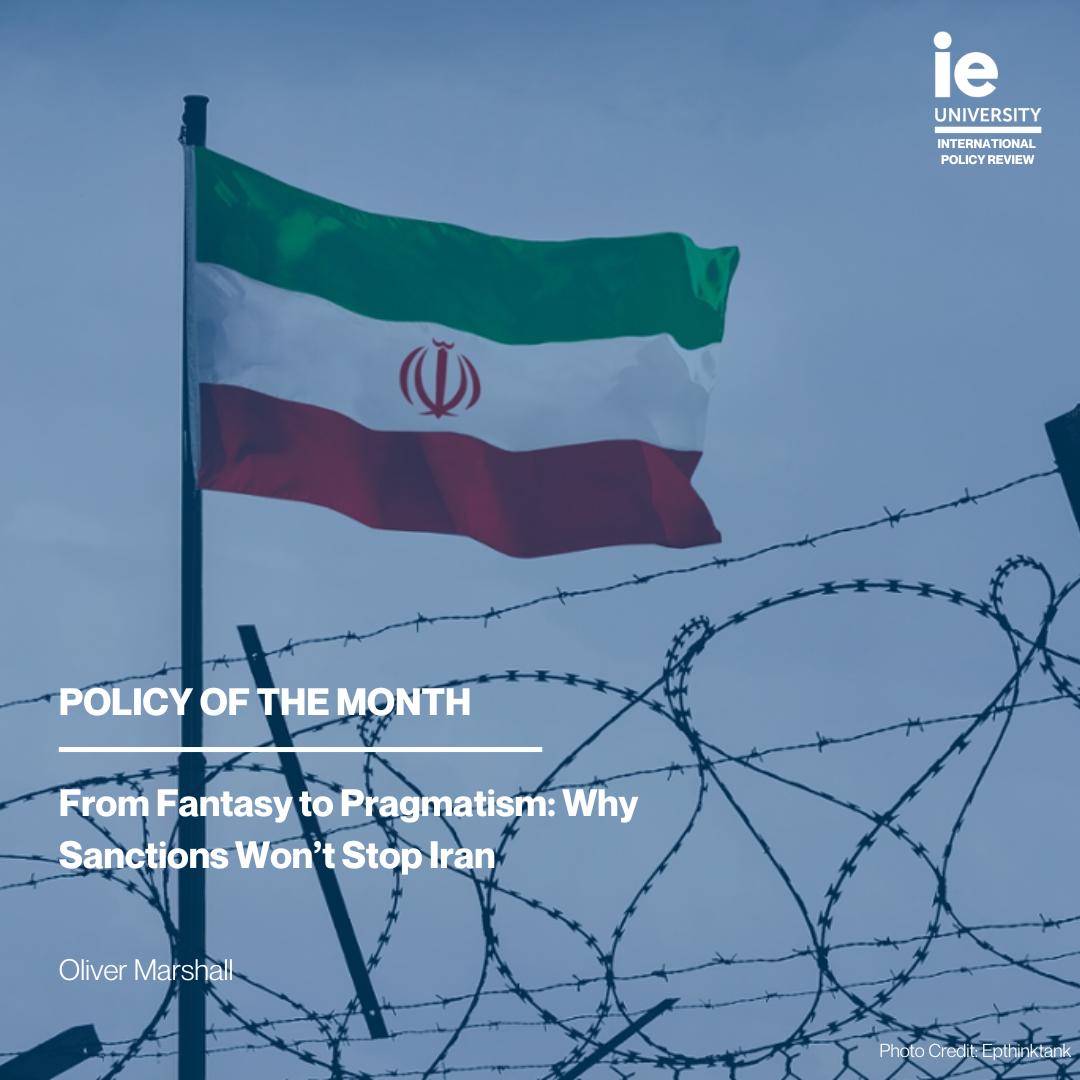
08 Dec POM – From Fantasy to Pragmatism: Why Sanctions Won’t Stop Iran
Oliver Marshall
International Policy Review – Policy of the Month
December 2025
On the 9th of October, the U.S. Treasury and State Departments concurrently announced comprehensive sanctions targeting approximately 100 individuals, entities, and vessels involved in Iran’s petroleum and petrochemical export network. This constitutes part of Trump’s “maximum pressure” campaign on Iran, denying them “all paths to a nuclear weapon,” and countering Iran’s “malign influence”. The administration has argued that these actors have collectively enabled the export of billions of dollars’ worth of petroleum products, which provides revenue for the Iranian government to support its terrorist groups who “threaten” the United States. This round of sanctions specifically targeted Chinese-based refineries, nearly two dozen shadow fleet vessels, networks facilitating oil-for-infrastructure payments, and Indian, Turkish, Chinese, and UAE-based intermediaries.Background
Since the 1979 Islamic Revolution, the U.S. has intermittently imposed sanctions on the Iranian government, notably since 2012 under the Obama administration, which heavily targeted Iran’s nuclear program. In 2015, the Joint Comprehensive Plan of Action (JCPOA) was formed as an agreement between Iran and the P5+1, temporarily lifting sanctions in exchange for Iran’s nuclear restrictions. However, in May 2018, Trump withdrew the U.S. from the agreement and reimposed sanctions. In August 2025, in light of the October expiration date of the JCPOA, the UK, France, and Germany triggered a snapback mechanism to re-impose pre-2015 UN sanctions, including arms embargoes, asset freezes, travel bans, and restrictions on nuclear and ballistic missile-related materials.Iran has continued to expand uranium enrichment activities – the International Atomic Energy Agency (IAEA) concluded in December 2024 and May 2025 that Iran was producing enriched uranium of up to 60 per cent and accumulating enough for several nuclear weapons if weaponised. Furthermore, since 2019, Iran has gradually reduced the IAEA’s capacity to monitor its nuclear activities, thus aggravating the situation. Recent months have thus seen an escalation in tensions between the West and Iran, with the 9th of October sanctions coming after Israeli and U.S. military strikes on Iranian nuclear facilities in June 2025.
READ THE FULL ARTICLE HERE
Sorry, the comment form is closed at this time.